
Short answer
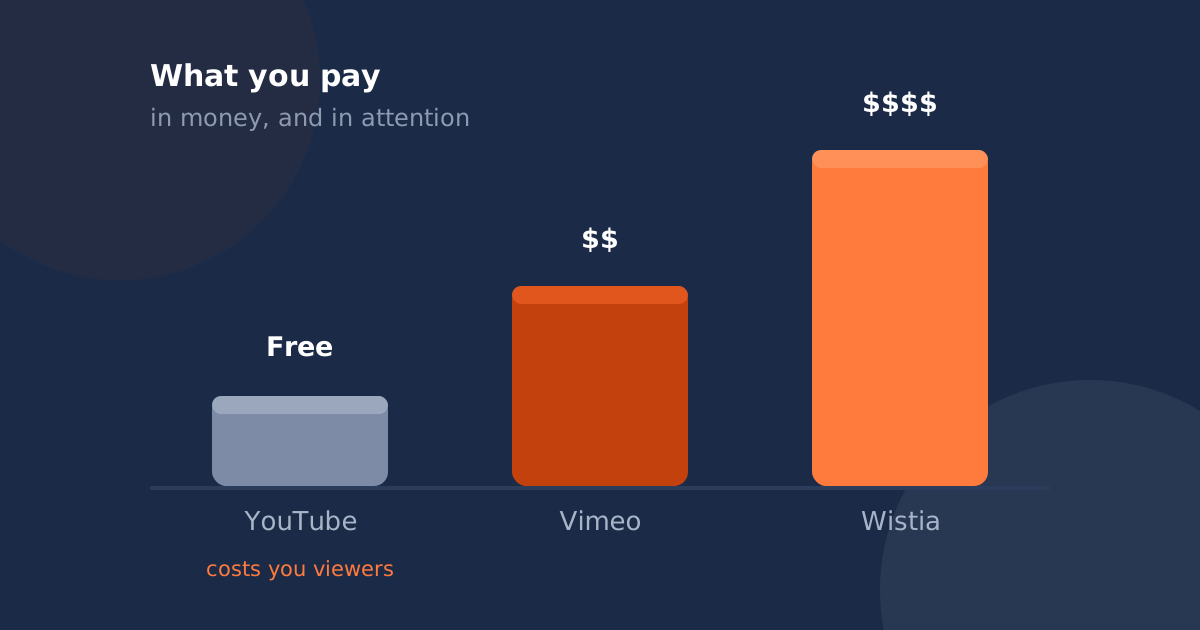
You are not really choosing between three video players. You are choosing what to pay for. YouTube gives away storage, bandwidth and reach, and takes payment in viewer attention at the end of every video. Vimeo and Wistia sell you a quiet player and detailed analytics, and expect a subscription that grows with your library.
If your videos are marketing assets on your own pages and you have fewer than a few dozen of them, the honest answer is usually that the hosting is not your problem. The presentation is.
Every comparison of these three platforms tends to be written by someone who sells one of them. This one is written by someone who sells a presentation layer, so treat the recommendation at the end with the skepticism it deserves and check the reasoning instead.
What each one is actually selling
YouTube
YouTube’s product is reach. Unlimited storage, unlimited bandwidth, transcoding to every device, a global CDN, and the second-largest search engine in the world pointing at your content, all for nothing. That is an extraordinary amount of infrastructure to be given away.
The price is paid at the end of playback, where the platform’s interests and yours separate. YouTube wants the viewer to watch another video. You want them to fill in your form. As covered in our piece on the rel parameter, you cannot switch that behavior off, only narrow it to your own channel.
Vimeo
Vimeo sells a clean, credible player and a calmer relationship with your audience. No suggestions from strangers, reasonable customization, privacy controls including domain-level restrictions, and a long history with people who care how their work is presented.
The constraints are storage and bandwidth. Plans are tiered by how much you upload and how much gets watched, so success is a cost event. Vimeo restructured its plans during 2026 and prices differ by region and billing period, so check their pricing page rather than trusting any number in a blog post, including this one.
Wistia
Wistia is not really competing on hosting at all. It is a marketing tool that happens to store video: per-viewer heatmaps showing exactly which seconds were watched, email capture inside the player, CRM and marketing automation integrations, and attribution tying a view to a deal.
That is genuinely valuable if someone in your organization acts on it. It is priced accordingly. Wistia’s published plans run from a free tier with 25 GB of storage and 200 GB of bandwidth, to Business at $79 a month, to a lead-generation tier at $329 a month, with annual billing advertised at 20 percent off.
Side by side
| YouTube | Vimeo | Wistia | |
|---|---|---|---|
| Storage and bandwidth | Unlimited, free | Tiered by plan | Tiered by plan |
| Suggestions after playback | Always, narrowable to your channel | None | None |
| Player branding | Not configurable | Configurable on paid plans | Configurable |
| Discovery and SEO reach | Very strong | Limited | None by design |
| Marketing analytics | Channel-level | Good | Best in class |
| Cost as your library grows | Flat, free | Rises | Rises steeply |
| Migration effort | None, you are there | Re-upload and re-embed | Re-upload and re-embed |
The question nobody asks first
Most people arrive at this comparison having decided something is wrong with their YouTube embeds, and assume the fix is a different host. It is worth separating the two problems, because they have very different price tags.
If your problem is hosting, meaning you need private video, no platform account, contractual guarantees, or the analytics Wistia is built around, then you need a hosting platform and the subscription is the cost of the thing you actually need.
If your problem is presentation, meaning the video plays fine but the embed looks like someone else’s product and ends by advertising other people’s videos, then you are considering paying hundreds of dollars a year to replace infrastructure that is working perfectly, in order to change a player skin.
That second case is common, and it is where a presentation layer makes sense: keep the free hosting, transcoding, CDN and search reach, and change only the part that was bothering you. For context, Vid Sharpei is $14.75 a month or $159 once, against a Wistia Business plan at $79 a month. That is not a like-for-like comparison, and it should not be read as one. Wistia does far more. The point is that if all you wanted was a player that ends on your call to action, you can buy that without buying a video platform.
Honest recommendations
- Choose Wistia if video is central to how you generate and qualify leads, and somebody will genuinely act on per-viewer engagement data. If nobody will open the dashboard twice, you are buying a report you won’t read.
- Choose Vimeo if you need real privacy controls, client review workflows, or a portfolio where presentation is the product, and your library is small enough that the tiers stay comfortable.
- Stay on YouTube if discovery matters to you at all, if your library is large, or if bandwidth costs would scale badly. The free infrastructure is genuinely hard to beat.
- Add a presentation layer if the only thing wrong is how the embed looks and what happens when it ends.
One thing all three share
Whichever you pick, an embedded third-party player has privacy implications for visitors in the EU and UK, and they do not disappear by switching hosts. If you have European traffic, read what youtube-nocookie actually does before you assume the question is settled.